Most people keep score by pegging along a wooden board. The usual tournament game is 121, twice around a long board plus the game hole. The drawing below is our own, and it is not to scale.
A simplified view of a 121-hole two-track board, with the four streets stacked so the holes stay readable. Drawing: our own, geometric, simplified and not to scale. A drawing of the board, not a scene with players. On a physical board the second and fourth streets usually run back beside the first and third; they are shown one under the other here on purpose.
Each player has a track of 120 counting holes, in four streets of 30, usually as two rows of 30 holes each way.
The game hole is hole 121. The dead hole is hole 120, one point short of game.
Each player has two pegs. The score is marked by jumping the rear peg in front of the front peg, so the latest increment stays visible.
The stink hole is hole 90, one point short of avoiding a skunk (a win by 31 or more).
ACC-sanctioned and satellite tournaments must be played on “long boards”: sixty holes up and sixty holes down.1 On the ACC board, a street is a stretch of 30 holes: first street is holes 1–30, second 31–60, third 61–90, and fourth 91–120.1
The dead hole is hole number 120, one point short of the game hole. The game hole is hole number 121.1 To skunk an opponent is to win by 31 or more points. The stink hole is hole number 90, one point short of avoiding a skunk.1
A player pegs by advancing the rear peg in front of the front peg. The board shows both the score accumulated so far and the size of the latest increment.1
Parlett describes the usual board as a tablet with 60 counting holes, in two rows of 30, for each player, plus one game hole for each. Game is 121 — twice around the board plus one for the game hole — or 61 in the less frequently played game of once around. Boards with 180 holes, for play to 181, also exist.2 Many descriptions have called the cribbage board indispensable. Encyclopaedia Britannica, in David Parlett’s article, says that it is not: the score can be kept with pencil and paper, or with chips or other counters.2
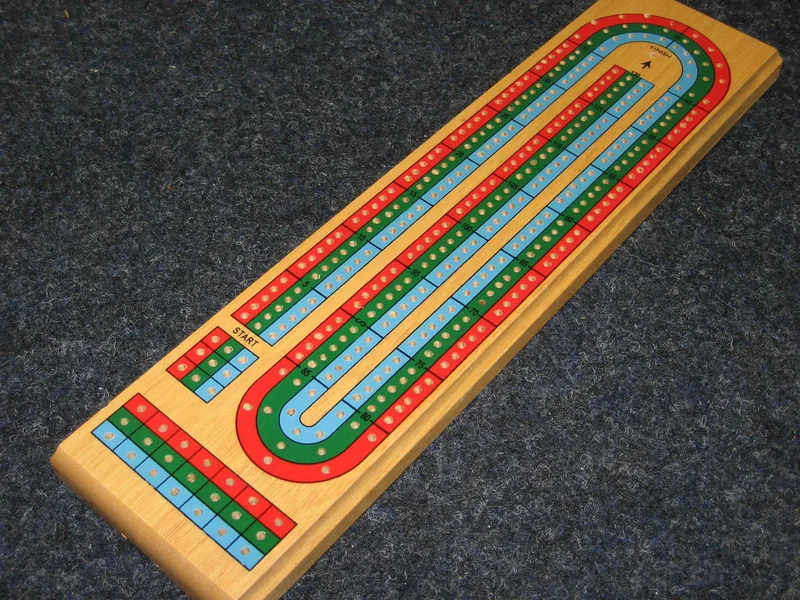
A continuous three-colour-track cribbage board, photographed by Heiko Arntz on 29 January 2007. The printed “START” and “FINISH” marks belong to this board; they are not a universal layout. Website only; not used in the paid printables.Photo: Heiko Arntz · CC BY-SA 2.0 de · Commons
Boards of other shapes
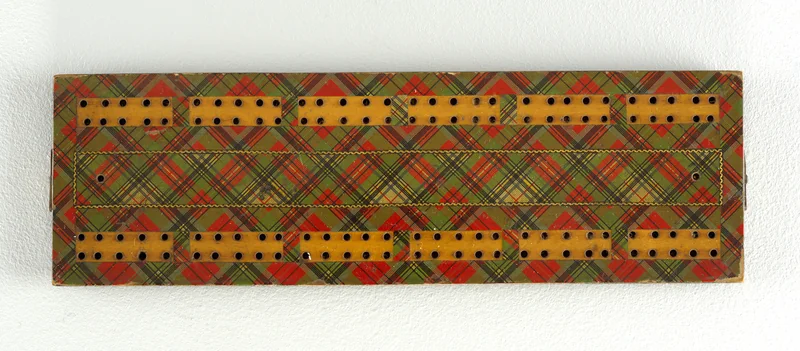
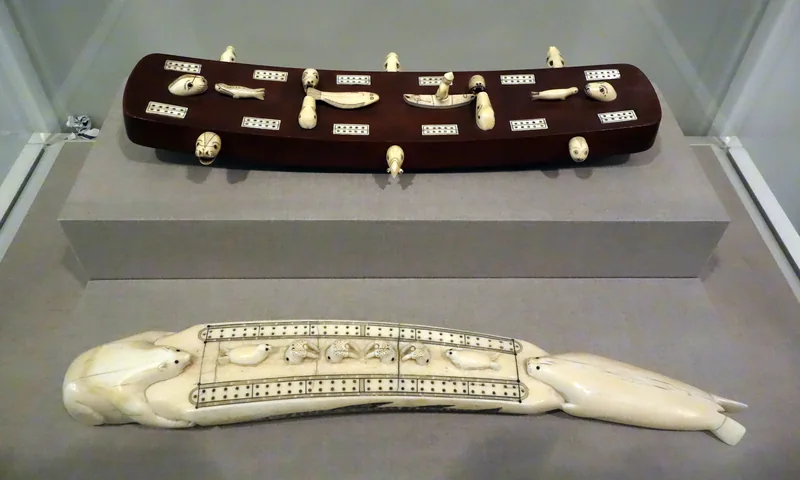
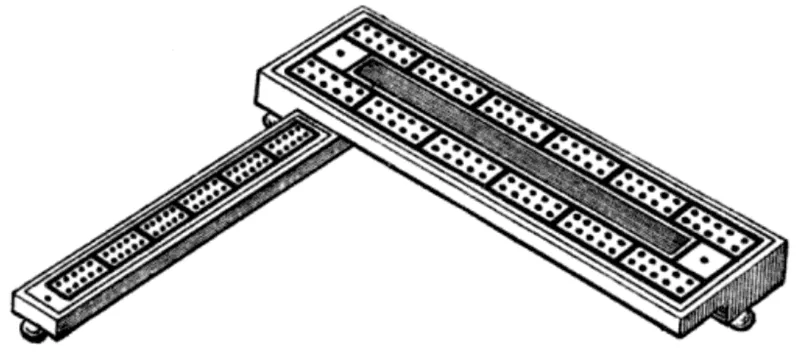
Not every historic board is a 121-hole long board. The 60-hole inlaid board on the deal page is a once-around board. A tartan-covered Scottish board from the late nineteenth century, Cup’ik boards from Nunivak Island, and a 1909 engraving from Hoyle sit on this page as photographs of real objects, each captioned with what it is and is not.
A tartan-covered cribbage board made in Scotland, about 1880–1900. Cooper Hewitt, Smithsonian Design Museum, object 18634303. The artist is not recorded.Photo: Unknown artist; Cooper Hewitt collection photograph · Public domain · CommonsTwo Cup’ik cribbage boards from Nunivak Island, Alaska, in the de Young Museum, San Francisco. The front board is dated about 1890 (walrus tusk, pigment, baleen); the rear board about 1890–1910 (wood, walrus tusk, pigment). Photograph by Daderot, 5 November 2013. The artwork is in the public domain; the photograph is CC0.Photo: Daderot · CC0 · CommonsTwo cribbage boards, from Hoyle’s Games Modernized (1909), a public-domain line engraving.Photo: “Professor Louis Hoffmann” (Angelo Lewis) and Ernest Bergholt · Public domain · Commons